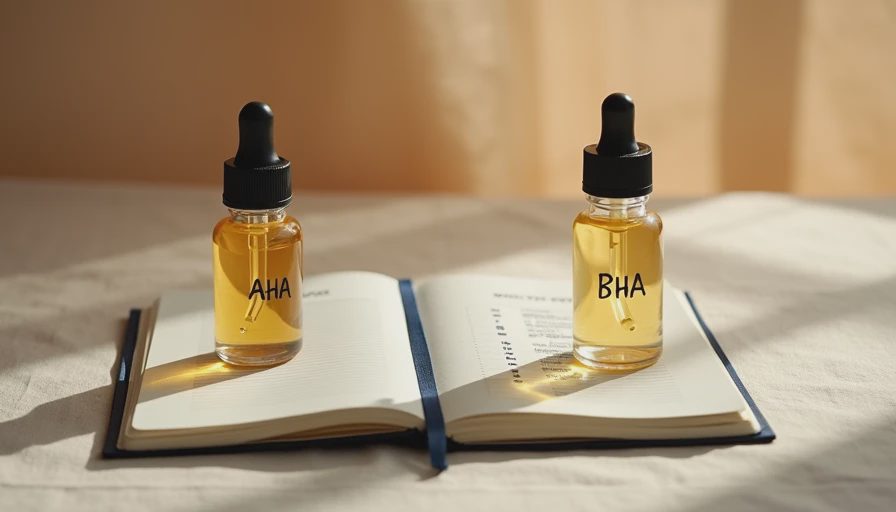
The Two Acids That Confuse Almost Everyone
Walk down any skincare aisle and you will see “AHA” and “BHA” on half the bottles. Some products claim both. Influencers treat them like interchangeable exfoliants. Clients used to ask me which one they needed while holding two serums that looked identical.
They are not the same. They work differently, suit different skin types, and behave differently on the label. Once you understand the basics, choosing between them (or deciding you need neither right now) becomes much simpler.
This is the plain-English version I wish someone had handed me years ago.
What AHAs Actually Do
AHA stands for alpha-hydroxy acid. The most common ones in skincare are glycolic acid and lactic acid. They are water-soluble.
AHAs work primarily on the surface of the skin. They loosen the “glue” that holds dead cells together so those cells shed more evenly. The result, when used correctly, is smoother texture, brighter tone, and a bit of help with fine lines over time. Glycolic has the smallest molecule, so it penetrates a little more effectively. Lactic is larger and often gentler, with some extra hydration benefits.
Because they stay mostly on the surface, AHAs are excellent for dullness, rough texture, and mild sun damage. They are less ideal if your main problem is deep congestion or acne inside the pores.
What BHAs Actually Do
BHA stands for beta-hydroxy acid. In skincare that almost always means salicylic acid.
Salicylic acid is oil-soluble. That is the key difference. It can move into the pore lining, dissolve excess sebum, and clear out the debris that leads to blackheads and clogged pores. It also has mild anti-inflammatory properties, which is why it shows up in so many acne formulas.
If your skin is oily, prone to blackheads, or gets congested, BHA is usually the more useful tool. It does some surface smoothing too, but its real strength is inside the pore.
How to Read the Label Like a Pro
Percentages matter, but so does the rest of the formula.
For AHAs:
Glycolic or lactic in the 5–10% range is common for leave-on products.
Higher percentages exist but increase irritation risk.
Look at pH if the brand discloses it—AHAs work best in a lower pH environment.
For BHAs:
Salicylic acid at 0.5–2% is the standard effective range for most leave-on products.
Higher than 2% is usually rinse-off or prescription territory.
Because it is oil-soluble, it often appears in formulas with lighter textures.
If the acid is listed near the end of a long ingredient list, the percentage is probably low. Marketing that screams “exfoliating” while the acid sits after twenty other ingredients is usually more story than substance.
Also check for soothing or barrier-supporting ingredients. A well-designed acid product includes things that keep irritation in check. A formula that is pure acid and nothing else is harder to tolerate.
Which One Do You Actually Need?
Dull, rough, uneven texture, early sun damage → start with an AHA
Oily, congested, blackheads, breakout-prone → start with a BHA
Combination concerns → some people alternate or use a product that contains both at low levels
Sensitive or currently compromised barrier → consider neither until the barrier is calm again
I have run half-face tests with both. On my combination skin, BHA keeps the T-zone clearer while AHA improves overall brightness. Using both every night is a fast way to end up with the tight, reactive feeling I described in the barrier-recovery post. One well-chosen acid a few nights a week is enough for most people.
How to Use Them Without Regret
Start low and slow. Two or three nights a week is plenty when you are new. Apply to clean, dry skin. Wait a few minutes before layering moisturizer. Use sunscreen every morning without fail—both AHAs and BHAs increase sun sensitivity.
If your skin stings, turns red, or starts flaking beyond mild adjustment, stop. Repair the barrier first, then reintroduce more gently. The goal is steady improvement over months, not a dramatic peel in a week.
I still keep both on the testing bench. I reach for BHA when congestion shows up and AHA when my skin looks dull after travel or winter. I never stack them with retinol on the same night unless my barrier is in excellent shape and I have built tolerance carefully.
Cost-Per-Ounce Reality
Effective AHA and BHA products exist at every price point. A simple 2% salicylic acid serum or a 5–8% lactic acid lotion does not need to cost $70. When the bottle is expensive, check whether you are paying for a well-stabilized formula and smart supporting ingredients or mostly for packaging and marketing language.
Learn the label, then choose. Look at the specific acid, the percentage if disclosed, the position on the ingredient list, and whether your current skin concerns match what that acid actually does. That short process will keep more useful products on your shelf and more money in your pocket.


No letters yet — be the first to write.