If you have searched for hyaluronic acid serum price, you have probably noticed a strange spread: some bottles cost $8, while others ask for $90 or more. I have stood in enough spa retail rooms and Sephora aisles to know that the highest price does not automatically mean the best hydration. The useful question is not simply what the bottle costs. It is what you get per ounce, which ingredients surround the hyaluronic acid, and whether the formula makes your skin feel comfortable after several hours.
Hyaluronic acid is a humectant, meaning it helps attract and hold water near the skin's surface. It is not a magical wrinkle eraser, and it does not replace moisturizer. A well-made serum can make dehydrated skin look temporarily smoother and feel less tight, but the formula needs water, a sensible preservative system, and a moisturizer layered over it to keep that benefit from disappearing.
The typical hyaluronic acid serum price range
At the drugstore, expect to see a hyaluronic acid serum price between about $8 and $20 for 0.5 to 1 ounce. Brands such as The Ordinary, Good Molecules, and CeraVe often sit in this accessible range, although their formulas and bottle sizes differ. These products can be perfectly reasonable choices when your main goal is basic hydration.
The middle tier generally runs from $20 to $45. This is where you will find products from La Roche-Posay, Vichy, Naturium, Paula's Choice, and similar brands. A higher price here may reflect a more elegant texture, additional soothing ingredients, stronger packaging, or better testing and quality control. Those details matter if you dislike sticky finishes or your skin reacts easily to heavily fragranced products.
Luxury serums can cost $50 to $100 or more. A premium hyaluronic acid serum price sometimes pays for multiple molecular weights, peptides, antioxidants, or a carefully refined texture. It can also pay for prestige packaging and a large marketing budget. Neither is automatically wrong, but you should be able to identify what the extra dollars are buying.
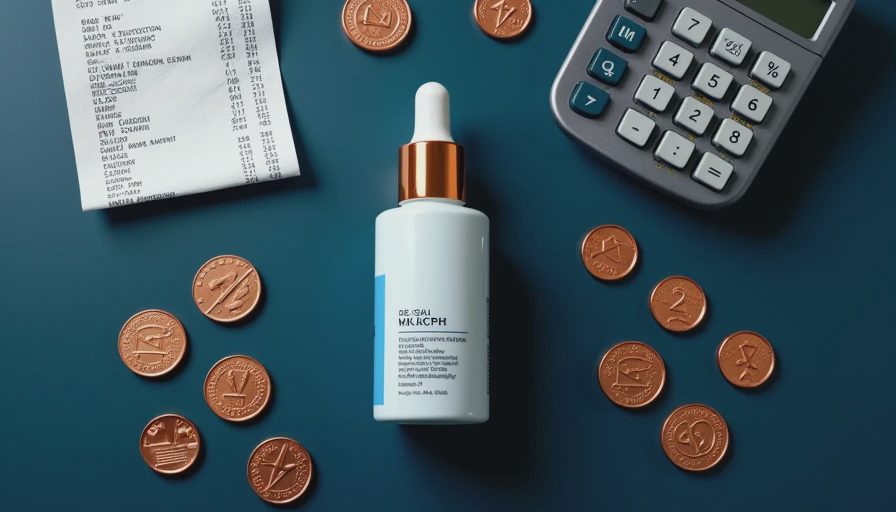
Cost per ounce tells a clearer story
The front-label price can be misleading because facial serums commonly come in 0.5-ounce and 1-ounce bottles. A $15 half-ounce bottle is effectively $30 per ounce. A $28 one-ounce bottle costs less per ounce even though the checkout total is higher.
To calculate it, divide the price by the fluid ounces. A $12, 0.5-ounce bottle costs $24 per ounce. A $22, 1-ounce bottle costs $22 per ounce. That two-dollar difference is not dramatic, but comparing a $70 half-ounce serum with a $30 one-ounce option reveals a much bigger gap: $140 per ounce versus $30.
Usage matters, too. If you use two or three drops once daily, a 1-ounce bottle may last three to five months, depending on the dropper and how generously you apply it. A product that costs $30 but lasts four months can be less expensive in your routine than a $15 bottle you replace every six weeks because of a small dispenser or larger application.
What deserves a higher price?
A more expensive product should offer more than the words “intense hydration.” Look for a formula that combines humectants such as glycerin, sodium hyaluronate, and hyaluronic acid with ingredients that support comfort, such as panthenol, beta-glucan, or allantoin. These supporting ingredients are often more meaningful than a dramatic percentage printed on the box.
Molecular weight is another point of comparison. Smaller forms can be formulated to sit differently within the outer layers of the skin, while larger forms tend to create a comfortable surface film. Marketing descriptions can make this sound more scientific than it is. Multiple forms may create a pleasant formula, but “three types” alone does not prove better results.
Pay attention to the finish. A serum that pills under sunscreen, leaves a tacky film, or stings around the nose is not a bargain for me, even if the hyaluronic acid serum price is low. Texture affects whether you use the product consistently, and consistency usually matters more than a glamorous ingredient list.
Affordable versus premium: a practical comparison
An affordable serum may be the smarter purchase when your skin is mildly dehydrated and you already use a good moisturizer. For example, a $12 formula with glycerin, sodium hyaluronate, and a fragrance-free base can handle the basic job. Apply it to slightly damp skin, then follow with moisturizer. That simple pairing often gives a softer feel without adding another expensive step.
A premium serum becomes easier to justify when you value a particular texture or need several supportive ingredients in one step. Someone who dislikes sticky formulas might prefer a $42 lightweight gel that layers cleanly under mineral sunscreen. Someone with easily irritated skin may value a fragrance-free formula with panthenol and soothing ingredients more than a basic formula with a lower sticker price.
The important comparison is not “cheap versus expensive.” It is $24 per ounce versus $110 per ounce, followed by a close look at the ingredient list and your actual experience. If the costly bottle does not improve comfort, layering, or ease of use, the added expense is mostly decorative.
How to read the label before buying
Start with the ingredient order, remembering that ingredients near the beginning usually appear in larger amounts. Water, glycerin, and a humectant blend near the top are common and sensible. Sodium hyaluronate may appear instead of, or alongside, hyaluronic acid. Do not assume one name is automatically superior.
Then check for fragrance if your skin tends to react to scented products. Fragrance is not inherently a problem for every person, but it can be an unnecessary variable when your goal is straightforward hydration. Essential oils also add scent and are not required for a serum to work.
Finally, inspect the packaging. An opaque or tinted bottle can help limit light exposure, and a pump may be more hygienic and less messy than a dropper. Packaging does not transform a mediocre formula, but it can improve the daily experience. If a product is $60, I want the texture, ingredients, and container to make a convincing case together.
My rule for deciding whether it is worth it
For most routines, I would first look for a serum in the $12 to $35 range, calculate the cost per ounce, and spend more only for a clear reason. That reason might be a better finish, a fragrance-free formula, useful supporting ingredients, or a bottle that lasts longer than the inexpensive alternative.
Do not buy a large collection of hydrating serums at once. Choose one, use it consistently for several weeks, and notice whether your skin feels less tight and whether your moisturizer applies more smoothly. If you see no practical difference, the next product should not automatically cost twice as much.
The best hyaluronic acid serum price is the one that fits both your budget and your routine well enough to be used. A $15 serum sitting unopened in a drawer has a higher real cost than a $30 serum you finish happily. Learn the label, then choose.

No letters yet — be the first to write.